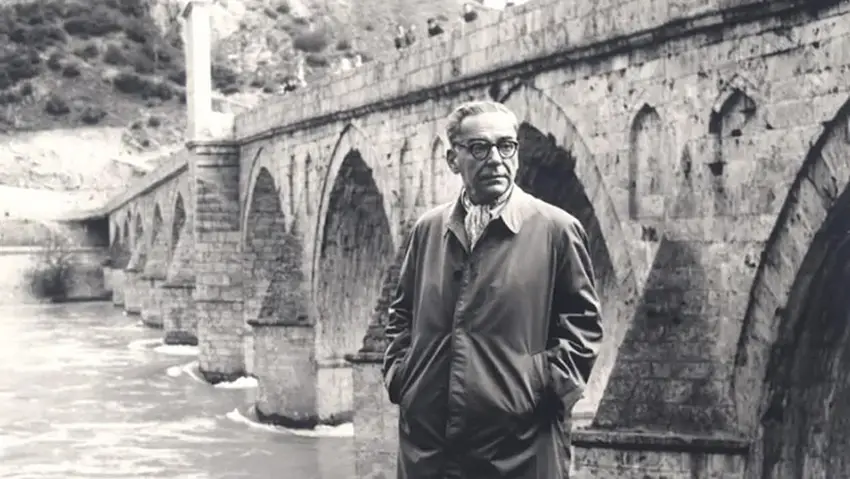
The Bridge on the Drina
Filipp Dvornik, 13 May 2026
I recently read Ivo Andrić’s The Bridge on the Drina, and I am very glad that we had the chance to discuss the novel at the welcoming Catoblepas Press Book Club.
If we agree that rapid communications have turned the world into a “global village” which, as McLuhan maintained, “absolutely ensures maximal disagreement on all points,” then the whole world resembles Bosnia. Before reading the novel, I suspected it would be timely; now I am certain I was right.
I made my way through the novel at an unhurried pace. More than a month passed between the opening pages and the ending, which I read just before the book-club meeting. At the same time, I was rereading Andrei Bely’s The Moscow Eccentric—a striking contrast with Andrić. Both are epic narratives, yet how far apart they stand in style and structure. Bely is grotesque, musical, prodigiously inventive in his epithets and neologisms; Andrić is dry and austere, detached, deliberately objective and naturalistic in his descriptions of the wildest human acts. Bely is restless, pretentious and graceful, painfully sarcastic and brilliant. Andrić is wise and muted, often even spare: he describes ordinary life without ornament, writes in aphorisms, and does not hesitate to pass judgement on events and people, assured of his right to hand experience down to the next generation—like Benjamin’s storyteller.
I will not discuss the novel’s structure. It is enough to say that its protagonist is the bridge: we watch its life from birth to death, while generations flow around it like river water, governments change, passions run their course and legends take shape, and the destinies of individuals and entire peoples flare up and drift away. Nor will I recount Bosnia’s complex and tragic history, which the novel lays out like an atlas.
I will leave here only two passages from this monumental novel, permeated by a quiet, concealed pain that may be difficult even to notice if one reads too quickly. It is the pain of the Grand Vizier Mehmed Pasha, the wise merchant Alihodja, the resourceful and sharp-witted hotelkeeper Lotika, the hopeless drunkard Salko the One-Eyed, and the poet Janko Stiković, filled with the spirit of national revival yet just as hopelessly lost on his way across the bridge. The first passage reminded me of the promises the world made fifteen years ago, when I was a student.
The sons of peasants, merchants and craftsmen from a remote Bosnian town had, without any particular effort, received from fortune an open road into the wider world and the illusion of unlimited freedom. Bearing all the traits of true sons of their native place, they set out into that wider world and, guided by their own inclinations, a passing whim or the caprice of chance, chose more or less independently their future field of study, their amusements and their circle of friends and acquaintances. Most of them could neither take nor knew how to take very much from the endless variety of goods displayed before them; yet there was not one who did not imagine, deep down, that everything was within his reach and could become his own. Life (a word used with extraordinary frequency in the literature, politics and conversations of the young people of that time, and written with a meaningful capital letter)—this Life appeared before them as a boundless field for liberated feeling, inquisitive curiosity and unfettered personal initiative. Innumerable roads opened into the distance. They would never take a single step along many of them, but the intoxicating sweetness of life lay in their being able, by their own will—at least in theory—to choose freely and pass from one road to another. Everything that the sons of other peoples, times and states had gained through the efforts of many generations, through centuries of persistence and patience, often at the cost of life, deprivation and sacrifices more burdensome and precious than life itself, had fallen to them as an unexpected inheritance, a dangerous gift of fate.
However fantastic and improbable it might seem, it was nevertheless plain that, amid the profound crisis then overtaking the laws of public and private morality—laws bounded somewhere in the distance only by a vague line of the impermissible, and constantly interpreted, accepted or rejected in contradictory ways by one group or another, or by individuals—they could dispose of their youth as they pleased. They could think and judge freely about everything without exception, say whatever came into their heads, and often substitute words for deeds: words that satisfied their atavistic thirst for the loud and heroic glory of rebels and destroyers without compelling them to take decisive action or assume responsibility. The most gifted among them scorned the discipline of compulsory courses and ignored their actual abilities; with all the fervour of youth, they devoted themselves to what they did not understand and what exceeded their strength. It is difficult to imagine a more dangerous way of entering life, or a surer road either to the heights of unparalleled achievement or to complete ruin. Only the brightest and strongest among them, possessed by the fanaticism of fakirs, threw themselves into action and burned up in it like moths; afterwards, in the halo of martyrs and saints—for no generation is without its saints—they were exalted by their contemporaries and raised onto the pedestal of an unattainable ideal.
Every generation nourishes its own illusions about civilization: some imagine themselves kindling its flame, others witnessing its extinction. In truth, the fire of civilization blazes, smoulders and goes out according to the position and angle from which it is viewed. The generation now discussing philosophical, social and political questions beneath the stars, at the gate above the river, was richer than other generations only in illusions; in every other respect it was no different. It too believed that it was lighting the torch of a new civilization and extinguishing the last flashes of the old one already burning out. Perhaps its unique trait was only its exceptional devotion to dreams. For a long time the world had not seen young people surrender themselves with such unbridled courage to dreams and arguments about life, happiness and freedom, receive so little from life, and suffer so many blows, so much pain and incalculable torment as awaited them. Yet in the summer days of 1913, the future still appeared to them only as a bold and indistinct destiny. On that ancient stone bridge, shining in the moonlight of July nights with the pure whiteness of beautiful, eternal youth, raised above the caprice of time and human schemes and imaginings, all of it seemed merely a new and thrilling game.
The other passage needs no comment.
And at last came 1914, the final year in the chronicle of the bridge on the Drina. It arrived at its appointed time with the unhurried tread of earthly time, like every year before it, accompanied by the distant roar of unprecedented events overtaking one another.
So many God-given years had flown over the town by the bridge, and how many more were still to fly! Yet in the motley succession of years past and future, 1914 would stand apart forever—at least in the minds of those who lived through it. However much they argued and wrote about that year, it seemed impossible to them—whether for lack of means or lack of courage—to put into words what had then been revealed, behind the temporal and transitory, in the depths of human destiny. Who, they thought, could convey the feverish shudder that shook whole masses of people and then passed from living creatures into inanimate objects, landscapes and buildings? How could anyone describe the falls and ascents of human beings, from mute animal terror to selfless heroism, from base bloodlust and filthy pillage to the greatest acts of sacred self-sacrifice, overcoming the individual self and for a moment admitting a mortal into the sphere of higher worlds governed by other laws? No, this could never be expressed in words: those who survived after seeing it had lost the gift of speech, and the dead cannot speak. Such things are not recounted; they are forgotten.
How else could they happen again?
The passages from the novel were translated into English for this publication from the Russian text quoted by the author of the essay. For bibliographic reference, the established English edition is Ivo Andrić, The Bridge on the Drina, translated by Lovett F. Edwards.