Limite and Mário Peixoto
Translated from the Portuguese material on pages 2–5 of Cine-Clube. The original comprises an editorial note and an interview with Professor Plínio Süssekind Rocha conducted by Paulo Emílio Salles Gomes and published in L’Âge du Cinéma.
Editorial Note
In keeping with the spirit of the film-society movement and the aims of our journal and its editors, we shall give Brazilian cinema as much space as possible. This year the most important event in Rio de Janeiro film-society life was a screening of Limite at the Cinematheque of the National Faculty of Philosophy (FNF). For all of us in the new generation, this screening was a revelation: to some extent it reconciled us with Brazilian cinema, and astonished us by showing that, under the conditions of the Brazilian film industry at that time, a young man scarcely older than ourselves had been able to create a work of art on such a scale.
Only one print of Limite survives, and it is already in very poor condition. It must be saved. We appeal to every Brazilian film-society member to help.
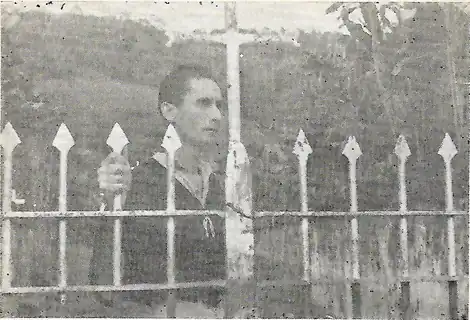 Mário Peixoto at the gate of the cemetery, one of the filming locations, years after the completion of Limite.
Interview with Plínio Süssekind Rocha
The study of cinema as an art began later in the Americas than in Europe. The pioneering movement of film culture, the Chaplin Club, did not emerge in Rio until 1927. It was founded by a group of young students, among whom Octávio de Faria and Plínio Süssekind Rocha were especially prominent. The former became one of the leading Brazilian novelists of his generation; the latter now teaches celestial mechanics at the University of Rio de Janeiro.
The Chaplin Club ceased its activities when sound cinema arrived in Brazil in 1930. Its legacy consisted of a complete run of O Fan—the first film-culture periodical in Latin America—and a film whose production was closely connected with the club’s activities.
That film is Limite; its creator, Mário Peixoto, was eighteen years old in 1929. European publications and filmmakers know almost nothing about it. The English journal Close-Up wrote about the film in 1930, and Jean Mitry knows that Limite exists. To the best of our knowledge, that is all.
We met Professor Rocha, who has never lost his interest in anything connected with cinema, and asked him to tell us about Limite.
—Professor Rocha, here is a film to which you have remained steadfastly loyal for more than twenty years. Throughout that time you have continued to see it again, and recently wrote to a friend that you feel ever more strongly that you are in the presence of the only work in the grand style created in Brazil during the past forty years. You will therefore understand our wish to learn as much as possible about it. Your visit to Paris offers us an exceptional opportunity.
—First of all, can Limite be associated with any current of the European avant-garde?
—Peixoto studied in England and often visited Paris. There he saw many excellent films, especially works by Russian, American, French, and German avant-garde filmmakers. Personally, however, I find in his film neither the marks of a school nor the influence of any master. Some young Brazilian critics disagree and occasionally invoke surrealism.
—Might Limite be one of those free games of images and themes sometimes found in avant-garde shorts?
—Not at all. Limite is constructed with extraordinary rigour, and it is a feature-length film. Its true unity is created by an overall rhythm based on editing of rare precision. At the same time, everything develops with complete logic at the level of meaning. One qualification is essential: in Limite, the story—or stories—cannot be understood without a sensitivity to the rhythm of the work as a whole.
For example, one character boards a train twice: the first time to travel, the second to flee. The latter action can be recognized and distinguished from an ordinary journey only by feeling Limite’s particular rhythm and its constantly recurring theme of escape. Even the concentration that Limite demands of its viewer is sometimes insufficient. At times one must compare two shots widely separated in time. A connection between them is established through their exactly equal duration, although their effect differs sharply from that of every other shot. Only once we have felt the film do we understand that a rational kinship exists between them as well: they are two expressions of one theme.
The principal example is the film’s opening image: a woman with her two handcuffed hands crossed before her face; the shot lasts almost a minute. The same duration returns at the end, in a shot where the camera travels from the head of an unconscious man down to his feet. At first, the equality of duration establishes a link between the two shots. Then the viewer understands that both express the defeat of the film’s characters and, more broadly, the defeat of humanity before the universal limit—the film’s central theme. I do not know whether these examples can move someone who has not seen the film. But anyone fortunate enough to see Limite in good condition and with the requisite receptiveness has felt rhythmic quality become dramatic quality.
—It is naturally difficult not to lose one’s way among references to separate episodes in an unfamiliar film. Could you give us a critical account while following the narrative sequence? That would provide a sense of the whole and allow us to place the elements you have mentioned.
—We must first acknowledge the strangeness of the undertaking: to recount in words what was conceived and embodied in images. With the pedantry inevitable in any didactic simplification, one might say that Limite contains a central theme, one situation, and three stories. The common theme is humanity’s eternally unsatisfied thirst for the infinite: the impulse shatters against limits of every kind, from the most ordinary to those revealed in an almost metaphysical contemplation of the universe. Expressed in words, the central theme of Limite risks becoming barren and cheap intellectualizing; in images it is alive, at times terrifyingly concrete, at times magnificently transposed into poetry. Let us accept the risk and recount Limite nonetheless.
You already know the first image: the woman in handcuffs. It is followed by the situation of three shipwreck survivors—two women and a man—in a boat. One woman is dark-haired and initially lies unconscious; the other is blonde. Each of the three characters tells an episode from their life. These are the three stories.
The blonde woman’s story is the first and shortest. She is in prison. A guard enters. Notice that whenever anyone enters or leaves in the film, doors and closed windows receive particular emphasis. With the guard’s help, the prisoner escapes and boards a train. Here, as almost everywhere, the editing does more than describe the action: every element belongs to the whole. The woman tries to work. The monotony of labour, the sewing machine, the scissors—everything tells us that this cannot continue. She leaves again by train. Now the rhythm of flight predominates: this is the final attempt, and it will lead her to shipwreck. Visually, only the rhythm of the fleeing train remains—and then we are back in the boat. The dark-haired woman is given water and regains consciousness. In despair, the blonde woman tries to row with her hands but sees that it is useless. It becomes clear that the man is still trying to help the other woman. Nothing has meaning any longer. The dark-haired woman then tells her story.
Details of the coast emerge: a small stranded vessel, plants, a fishing village. A boat approaches; the woman buys fish and walks for a long time through the town. The camera attentively follows the swinging basket and her arm. A feeling of fatigue arises and steadily intensifies, but everything is arranged to bring the moment of her return home to the height of expression: a small flower, an encounter with a man. The woman stops; they are no more than half a metre apart, yet shot and reverse shot express an infinite separation. The rhythm changes and the woman comes home. Closed doors and windows, bare walls: the house resembles a fortress. Until now the camera has followed her without pause, but it stops abruptly when she enters. At the top of the stairs she sees her husband sitting on the floor, a wretched man. She looks at her wedding ring; then we see his hand, and a dialogue of hands begins. The woman puts down her basket and leaves once more. Her departure is intercut with her husband’s story: the viewer sees the beginning of The Adventurer, in which Charlie Chaplin climbs out of the hole he has dug only to find himself at a guard’s feet. The audience’s laughter expresses all the vulgarity of the situation. The woman walks away toward the highest point in the landscape.
She wants to escape, but looks in fear at the limit drawn by the horizon. Peixoto offers no happy resolution: the camera’s movement closes into a circle and the close-ups of the woman become ever tighter. The editing has the same rhythm as the train sequence, and we understand that the story is over: this woman too has been shipwrecked.
We return to the boat. Its sides become increasingly tangible; they suffocate us. When the camera releases us from them and rests on the horizon, the horizon proves no less suffocating. The man, playing with a splinter of wood, begins his account. The camera moves upward from the feet: we see the legs of a man and a woman, but throughout the story we shall never see their faces. We are on a beach—vast and beautiful in this third story. The man and woman bathe; the rhythm is joyful. Even boundaries appear benevolent: railings look cheerful and the lines of fences separating flowering gardens are attractive, all conveyed through a light allegro movement.
The man accompanies the woman home; she wears a wedding ring. He then goes to a cemetery, where another man awaits him. In the next scene, the other man tells him that the woman has leprosy, but he does not care. This, incidentally, is the only sequence in Limite to use intertitles. The story is interrupted by a return to the boat. The man continues speaking, still holding the small piece of wood. He plays with it. At first glance the image is the same as at the beginning of his story, yet it has changed: a light wind causes the slightest movement, and the theme of the limit now sounds in a minor key. The man leaves the cemetery and his interlocutor follows him. The theme of despair begins. The protagonist walks for a long time, questioning everyone he meets; nature shares his anguish. In a gently developing fugal rhythm, trees repeatedly recede in negative images; the sequence carries the man toward vertigo. Its final moments are constructed like the scene with the woman on the hilltop.
The man falls unconscious. We are back in the boat. The splinter of wood floats away. The man decides to kill himself. In purely narrative terms the sequence is superb: he moves toward the side, the dark-haired woman seizes him, but the blonde woman gestures for her to let go. The man looks at the blonde; she nods, and he throws himself into the water. Close-up of the dark-haired woman. The rhythm accelerates. The storm that follows is the film’s climax, one of the most brilliant manifestations of the art of editing I know. The episode lasts several minutes and is built entirely from different combinations of seven short shots. Each clearly shows that we are not on the open sea, that the waves and foam are close to shore. Yet through editing alone Peixoto creates one of the most beautiful storms in the history of cinema. After the storm we see the boat filled with water; the water drains away while the blonde woman, frantic with despair, tries to cling to one side. The final shot repeats the first.
I should add that if my account has given the impression that Limite is an abstract, rootless work, then I have proved an inept narrator. On the contrary, we owe to Peixoto the poetic discovery of the Brazilian coast in cinema. Everyone who later tried to create good Brazilian cinema on this ground followed in his footsteps.
I would not be surprised if a viewing of Orson Welles’s Brazilian documentary, held in the RKO archives, revealed that the Rio screening of Limite was a revelation for Welles himself. In closing, I want to note something important to anyone interested in Peixoto’s later work: he had the good fortune to collaborate with a cinematographer of exceptional calibre, Edgar Brasil.
—Forgive me, Professor Rocha, but after all you have said, allow me a question that may seem idle. I ask it in the hope of receiving an answer capable of summing up everything you have told us about Limite. Do you believe in the film’s historical and worldwide importance?
—Whenever I have followed historical retrospectives of cinema—for example, during the latest season at the Paris film museum—I have invariably felt that without Limite, the picture of silent cinema is incomplete.
—And finally, do you have any recent news of Mário Peixoto?
—After Limite, made with his own money and yielding no profit, Peixoto began a new film with the Brazilian actress Carmen Santos. Financial difficulties left it unfinished, and many years have passed since then. Peixoto has not been able to make another film. But he is still young, full of ideas, and eager to work. The present resurgence of Brazilian cinema, founded on a solid industrial base, should allow him to resume his career. Peixoto has shown himself to be a first-rate director of actors and is capable of making films for a broad audience.