Limite: Screenplay Excerpts
Translated from Portuguese. Pages 13–16 of Cine-Clube. English shot terminology has been standardized.
1
Close-up — Woman 1’s mouth recedes slightly; she turns her face and looks at Man 1, who has just finished eating and sits hunched and dejected. (The remainder of the scene is filmed over Man 1’s back.)
Dissolve. Close-up — Woman 1’s hair, seen from the front.
Dissolve (camera slightly above) — water and the side of the boat.
Dissolve (same shot as the preceding scene) — prison bars and Woman 1’s face behind them. The camera moves left toward the door and reaches a close-up of the lock, then descends to the floor as a man’s feet enter the frame. The door is ajar. The camera pulls back, keeping the lower part of the door in frame throughout, and waits.
Full shot — the door opens; Woman 1’s feet emerge. She adjusts her dress; the jailer’s feet follow. The woman prepares to leave but is held back. (The scene is framed from feet to waist.)
Full shot to close-up — the man’s hands hold the woman by the arm. Pause. After several attempts she breaks free. (Pan following the departing woman; empty bars are visible in the background; the camera moves in toward them.)
Shot — Woman 1 walks along the pavement.
Shot — Woman 1 walks down the street.
Tracking shot — the edges of roofs pass by.
Dissolve — treetops pass by.
Dissolve. Shot — the woman stands in the road, removes her hat, opens her handbag, and wipes away sweat with a handkerchief. (The camera circles her completely and returns to its starting position.) She walks on with her hat in her hand; the camera accompanies her. Suddenly she leaves the frame; the camera continues along the empty road, turns left, and keeps the road, now seen from the side, and a scorched strip of ground in frame. It stops, retraces its path, and reaches a rail of a simple country gate. The woman sits exhausted on one of the rails. The camera approaches Woman 1 and holds her for a time.
Dissolve — a train wheel begins to turn.
Dissolve — the wheel of a sewing machine turns. (Superimposed over a tracking shot toward a misted window.)
Shot — through the window, from above: Woman 1 at the sewing machine.
The woman sews.
Close-up — the machine needle and the fabric being worked.
Close-up — Woman 1 stops sewing, adjusts her hair and the thread on the spool, and looks out of the window.
Shot — the window; roofs and sky outside.
Dissolves — successive dissolves: darning egg; spool; presser feet; button; measuring tape; scissors.
Close-up — the woman emerges from her reverie and begins sewing again.
Shot — through the window from outside and above: Woman 1 sews at the machine. When finished, she takes the scissors and cuts several scraps from the fabric, then looks for a time at the scissors in her hand.
Extreme close-up — open scissors in her hand. She runs a finger along one blade’s cutting edge as if testing it.
Extreme close-up — the blade of the open scissors.
Dissolve — a newspaper page seen edge-on, resembling the cutting edge of the scissors.
Shot — Woman 1’s feet at the door of the house. The camera rises, then shows in close-up the back of the newspaper she is reading. The words “Prison Escape—with the Assistance of a Jailer,” and so on, can be read. The woman turns the paper (it is clear that she will now find the report). The camera descends to Woman 1’s feet and passes between them; a ladder is visible running down her stocking.
Shot — the roof of a house; a hunched urubu perched upon it; grey sky.
Shot — pavement. The wind drives dry leaves, someone’s hat, and a newspaper along the ground.
Shot — the open door of Woman 1’s house bangs in the wind. Dust and litter rise into the air.
Dissolve — a rapidly turning train wheel, filmed from two angles.
Dissolve. Close-up — in the boat: Woman 1’s face after she has finished speaking; she looks toward Man 1 outside the frame.
Full shot — Man 1, leaning over the side of the boat, lightly rubs together two splinters held in his hand.
Close-up — Man 1’s hand and the two splinters; the sea and part of the boat’s side are visible below.
2. Happy Time
Long scene.
- The man with two splinters in his hand.
- Close-up — hand and splinters.
- Long shot — a tongue of land; a barely visible couple walks into the depth of the frame. Superimposed over the preceding close-up, which scarcely disappears before the end.
- Medium shot — the walking couple, framed from the waist down.
- Close-up — their intertwined hands against the boundless sky.
- Part of a trunk, filmed upward from below, crossing the frame.
- Full shot — the same trunk, filmed downward from above; calm water and land in the distance.
- The reflection of openwork treetops in still water. Full shot.
- The couple bathing; only their legs are visible.
- Boards against a beautiful sky.
- Coconut palm.
- Post.
- Tree; a narrow strip of field at the bottom of the frame.
- Branch with parasitic plants.
- Almost withered branch bearing only a few shoots.
- Completely dry tree without branches.
- Field and couple, filmed from nearby.
- Field and couple, filmed from afar.
- Ruin; plants grow between the stones.
- Ruined arcade.
- Cacti on the sand.
Gloomy Time
Short scene. Every angle is repeated exactly; only the sky has changed and one tree has fallen. Wind.
- The man with two splinters in his hand; his hair blows in the wind.
- Close-up — hand and motionless splinters.
- Long shot — the empty tongue of land.
- Superimposition. The couple’s footprints in the sand. The camera moves slowly downward, following them.
- Close-up — one deliberately isolated footprint. In the distance, the crest of a quiet wave reaching shore (negative image).
- Close-up — part of a trunk, filmed downward from above (negative image).
- Full shot — the same trunk, filmed downward from above; calm water and land in the distance (negative image).
- Full shot — the reflection of the treetop trembles in the water.
- The couple bathing; this time only their backs are visible.
- Boards against a gloomy sky (negative image).
- Coconut palm (negative image).
- Post (negative image).
- Tree with a narrow strip of field at the bottom of the frame. The tree has fallen; the sky is gloomy.
- Branch with parasitic plants; gloomy sky.
- Almost withered branch bearing only a few shoots; gloomy sky.
- Completely dry tree without branches; black sky.
- Empty field from afar; wind moves the tall grass.
- Empty field nearby; wind moves the grass more violently.
- Ruin; a plant grows between the stones; black sky.
- Ruined arcade; black sky.
- Cacti on the sand; their tone is even more scorched in this shot.
3. Rhythm of the Fountain
Cut. Close-up — channel tiles on an old colonial roof. The camera is level with the tiles; focus moves from one edge to the other, receding into the depth of the frame. The camera pauses at an angle and takes in the entire roof: endless rows of tiles seem locked together. It shifts right toward the roof slope; the street below, the rest of the block, and fragments of a distant village panorama enter the frame. The camera swings left in a true pendular movement, again taking in the centre of the roof already shown and then its left slope. A new view of the village opens: houses and small streets. The camera swings back and forth three times in the same movement and finally stops on an extreme close-up of the first tile shown.
Cut. Full shot. Low camera angled upward — an old spring built of dressed stone, from which a thin stream of clear water flows continuously. The camera remains still for several seconds, then moves in extremely rapidly to a close-up of the opening from which the water bursts. It stops.
Cut. Full shot. Low camera — an old public fountain converted by the residents into a stone washhouse. With her back to the camera, a washerwoman in an old straw hat rinses clothes and places the wrung garments in a tin basin on the pool’s broad rim. The camera pans slowly in the opposite direction, taking in a long stretch of a modest village street. In the foreground, at the beginning of the lane, the side wall of a small colonial stone bridge with a vaulted arch enters the frame. Geese walk across it, preening with their beaks. Farther away, a boy sits on a crumbling kerb and idly plays with a bamboo stick. The camera’s pan encompasses everything described.
Cut. Full shot. Low camera angled upward — the same view of the small spring and stream described in the preceding shot. The camera merely moves in extremely rapidly toward the stream twice in succession, taking it in close-up each time. It approaches and stops.
Cut. Full shot. Low camera — through the ends of a plank walkway, Man 1 is seen approaching the camera. When his chest completely fills the frame, the camera tilts upward—the passing sky is visible—and then descends; the ends of the boards re-enter the frame. The camera films Man 1 from behind as he walks into the depth of the frame until he is seen in full shot.
Cut. Full shot — panoramic tracking shot; camera at normal height. The same stretch of land; plants pass indistinctly before the lens. The shot has the same duration.
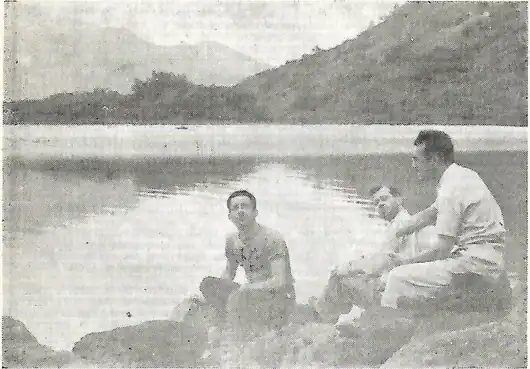 During the filming of Limite: Ruy Costa at right, Edgar Brasil in the centre.